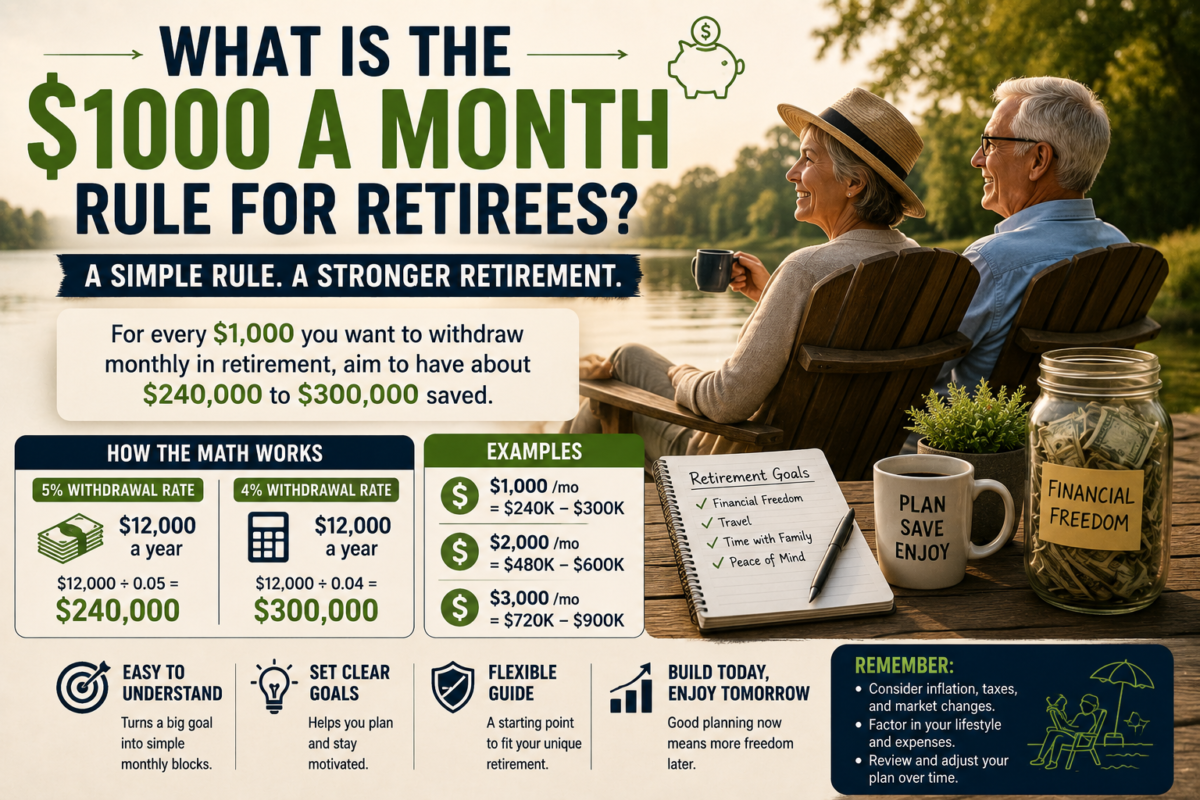
The $1000 a month rule for retirees is a simple way to estimate how much money you may need saved to create steady retirement income. In plain terms, it says that for every $1,000 you want to withdraw each month in retirement, you should aim to have about $240,000 to $300,000 saved, depending on the withdrawal rate used.
Understanding the Rule
This rule is popular because it turns a big retirement goal into a smaller, easier-to-grasp number. Instead of wondering how much money you need for the rest of your life, you can think in monthly income blocks of $1,000.
The idea comes from withdrawal-rate thinking, especially the 4% and 5% rules. A 5% withdrawal rate suggests about $240,000 can produce roughly $1,000 a month, while a more cautious estimate closer to 4% pushes that figure higher, toward $300,000.
In other words, the rule is not about spending exactly $1,000 a month on groceries or bills. It is about building enough retirement savings to generate that amount of income every month.
How The Math Works
The math behind the rule is very straightforward. If you want $1,000 a month, that equals $12,000 a year, and that yearly amount is then matched against a safe withdrawal estimate from your savings.
Using a 5% withdrawal rate, you would divide $12,000 by 0.05, which gives about $240,000. Using a more conservative approach closer to 4%, the number rises because your savings must last longer.
Here are a few simple examples:
$1,000 a month = about $240,000 to $300,000 saved.
$2,000 a month = about $480,000 to $600,000 saved.
$3,000 a month = about $720,000 to $900,000 saved.
This makes the rule useful for quick planning, especially if you want to estimate your retirement target without opening a giant spreadsheet right away.
Why Retirees Use It
Retirees and pre-retirees like this rule because it is easy to remember. It gives a fast answer to a common question: “How much do I need saved to produce the income I want?”.
It also helps people break retirement planning into clear steps. If you know you need $3,000 a month, you can work backward and estimate your savings target instead of guessing.
Another benefit is motivation. A large retirement number can feel scary, but monthly income goals feel more manageable and practical. For many people, thinking in chunks of $1,000 makes the process feel less overwhelming.
What It Does Not Tell You
Even though the rule is helpful, it is still only a rule of thumb. It does not fully account for inflation, market ups and downs, taxes, or how long retirement will last.
It also assumes your retirement money is invested in a way that can support regular withdrawals. If your portfolio is too conservative, too aggressive, or too small, the rule may not fit your real situation.
Your personal spending matters too. A retiree with paid-off housing and low medical costs may need less than someone who is still paying rent, helping family, or traveling often. So the rule should guide your planning, not replace it.
How To Use It
Start by estimating how much monthly income you want in retirement. Then compare that amount with expected income from Social Security, pensions, or other sources.
For example, if you want $3,000 a month but expect $1,500 from Social Security, then your savings only need to cover the other $1,500. That means the $1000 a month rule can help you estimate the savings needed for the remaining income gap.
A simple way to use the rule is this:
Decide your monthly retirement income goal.
Subtract guaranteed income sources.
Multiply the remaining monthly amount by the rule’s savings estimate.
Review the result as your lifestyle, health, and costs change.
This keeps the math simple while still giving you a practical starting point.
Is It Enough For Retirement
The honest answer is: sometimes, but not always. For some retirees, the rule gives a good starting estimate and feels close to reality.
For others, it can be too simple. Retirement is shaped by living costs, healthcare, travel, debt, family support, and how long your money needs to last. Because of that, two people who both want $1,000 a month may need very different savings plans.
That is why many financial sources treat it as a planning shortcut, not a final answer. It works best when combined with a broader retirement budget and a realistic look at your actual expenses.
A Simple Takeaway
The $1000 a month rule for retirees is a quick planning method that estimates how much savings you need for every $1,000 of monthly retirement income. In most versions, the rule suggests around $240,000 to $300,000 for each $1,000 a month you want to draw in retirement.
It is easy to understand, easy to apply, and useful for setting rough retirement goals. Still, it should be treated as a starting point, not the final word on your retirement needs.
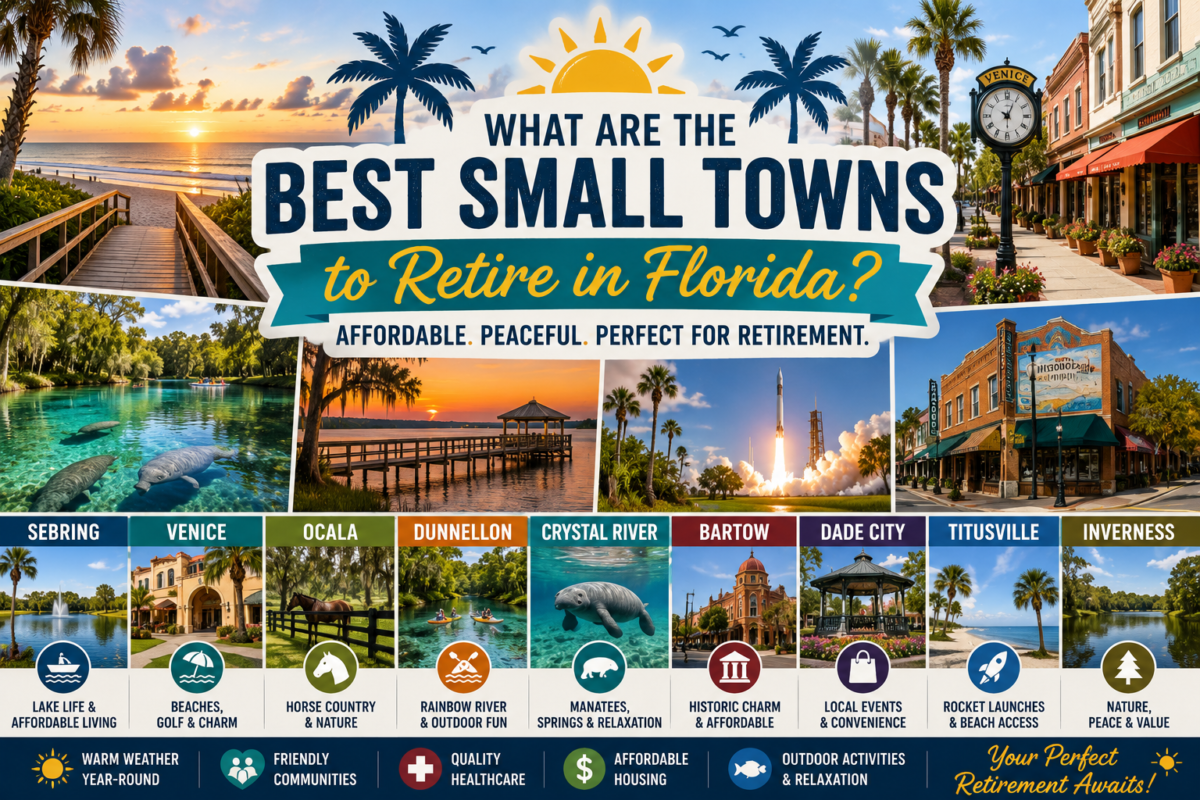
Planning to retire in Florida? You’re not alone. Thousands of people flock to the Sunshine State every year, looking for warm weather, affordable living, and a peaceful community to enjoy their golden years. But while big cities like Miami and Orlando get all the attention, some of the best places to retire are actually small towns. These hidden gems offer charm, lower costs, friendly neighbors, and all the Florida perks without the hustle.
If you’re searching for “What are the best small towns to retire in Florida?” you’re probably looking for real, practical info—not just a list of fancy names. You want to know which towns are affordable, safe, have good healthcare, and offer a lifestyle that fits your retirement goals. That’s exactly what we’re here to do: answer your question clearly, helpfully, and with tons of useful details.
Let’s dive into the top small towns in Florida that are perfect for retirement.
1. Sebring: Affordable Central Florida Charm
Located in Central Florida, Sebring is a budget-friendly town that’s quickly becoming a favorite for retirees. With an average home value of just $234,666, it’s one of the most wallet-friendly options in the state.
Why Retirees Love Sebring:
Low Cost of Living: Housing prices are well below the Florida state average ($369,996), making it easy to stretch your retirement savings.
Lakefront Lifestyle: Sebring is known as the “City of Lakes,” with over 30 lakes perfect for fishing, boating, and peaceful waterfront views.
Hungover Horse Events: The town hosts the annual Hungover Horse Trials, a prestigious equestrian event that draws visitors from around the country.
Friendly Community: Small-town vibes mean you’ll know your neighbors and feel part of a close-knit community.
Near Healthcare: While small, Sebring has access to quality healthcare facilities in nearby Lake Wales and Orlando.
Sebring is ideal if you want affordability, lake life, and a quiet pace without being too far from bigger cities.
2. Venice: Walkable Coastal Charm with Golf & Beaches
If you love the idea of retiring near the beach but don’t want the chaos of a big coastal city, Venice is a perfect fit. Often called “The Sedano of Florida,” Venice offers walkable charm, excellent golf courses, and a relaxed coastal lifestyle.
Why Venice Stands Out:
Beach Access: Venice Beach is known for its quiet shores, shark fossil hunting, and beautiful sunsets.
Walkable Downtown: The historic Venice Island and downtown area are packed with shops, restaurants, and cafes—all within walking distance.
Golf Culture: dozens of golf courses make Venice a top choice for golf-loving retirees.
Healthcare: Venice has top-rated medical facilities, including Venice Hospital and specialty clinics.
Active Senior Community: Many 55+ communities and social clubs keep retirees engaged and connected.
Venice is great if you want coastal living with culture, walkability, and a strong senior community.
3. Ocala: Small-Town Charm with Nature & Affordability
Ocala, located in north-central Florida, offers small-town charm, affordability, and plenty of access to nature. It’s often ranked among the best retirement cities for those who prefer a quieter, inland setting.
What Makes Ocala Great for Retirees:
Horse Country: Ocala is known as the “Horse Capital of the World,” with over 120 horse farms and equestrian events.
Affordable Housing: Home prices are lower than many Florida coastal towns, making it easy to buy without stretching your budget.
Nature Trails & Parks: The town is surrounded by beautiful state parks, including Silver Springs and Ocala National Forest.
Slow-Paced Lifestyle: Perfect if you want to avoid traffic, crowds, and the noise of big cities.
Good Healthcare: Ocala has multiple hospitals and medical centers, including Ocala Regional Medical Center.
Ocala is ideal for retirees who love horses, nature, and a calm, rural lifestyle.
4. Dunnellon: Budget-Friendly Riverfront Town
Dunnellon, tucked between Ocala and Orlando, is a budget-friendly town with a stunning riverfront setting. Home to the famous Rainbow River, Dunnellon is perfect for retirees who love water activities and natural beauty.
Why Dunnellon is a Retirement Gem:
Average Home Value: Around $267,289, making it one of the more affordable towns in Florida.
Rainbow River Access: Crystal-clear waters make it perfect for swimming, kayaking, and snorkeling.
Quiet & Peaceful: Dunnellon is known for its slow pace, friendly neighbors, and lack of crowds.
Near Orlando: You’re only 45 minutes from Orlando, giving you access to big-city amenities without living in the city.
Outdoor Lifestyle: Hunting, fishing, and hiking are popular here, thanks to nearby state forests and wildlife areas.
Dunnellon is perfect if you want nature, affordability, and a quiet life with easy access to Orlando.
5. Crystal River: Affordable Riverfront Living
Crystal River, on Florida’s northwest coast, is another affordable riverfront townthat’s perfect for retirees. Known as “The Manatee Capital of the World,” it’s a haven for nature lovers and wildlife enthusiasts.
Why Crystal River Appeals to Retirees:
Low Home Prices: Average home value is $264,924, well below the state average.
Manatee Viewing: During winter months, you can see manatees in the clear waters of Crystal River.
Freshwater Springs: The town is surrounded by beautiful springs perfect for swimming and kayaking.
Small-Town Friendly: A tight-knit community where everyone knows your name.
Near Tampa: Just 50 minutes from Tampa, you get big-city healthcare and shopping without the city stress.
Crystal River is great if you love wildlife, springs, and a peaceful riverfront lifestyle.
6. Bartow: Historic Charm with Affordable Housing
Bartow, in central Florida, is a small town where history comes alive. With an average home value of $269,685, it’s another affordable option for retirees looking for charm and community.
What Makes Bartow Special:
Historic Downtown: Walkable streets with old-school shops, cafes, and local boutiques.
Affordable Housing: Prices are below the Florida average, making it easy to buy a home on a retirement budget.
Close to Lake Wales: You’re just minutes from Lake Wales, which offers more healthcare, shopping, and dining.
Quiet Pace: Perfect if you want to avoid traffic and crowds.
Friendly Neighbors: Small towns like Bartow are known for their warm, welcoming communities.
Bartow is ideal for retirees who love history, affordability, and a slow-paced lifestyle.
7. Dade City: Central Florida Affordability with Local Flair
Dade City, in central Florida, is an affordable town with a lot of local charm. The average home value is $314,598, which is still below the state average.
Why Dade City is Great for Retiring:
Weekly Farmer’s Market: The historic downtown hosts a popular weekly farmer’s market with local produce and crafts.
Affordable Housing: Home prices are reasonable for Florida, making it easy to stretch your retirement income.
Close to Orlando: Only 45 minutes from Orlando, giving you access to big-city amenities.
Community Events: Dade City hosts festivals, parades, and local events throughout the year.
Good Healthcare: Nearby facilities in Winter Haven and Orlando provide quality medical care.
Dade City is perfect if you want affordability, local events, and easy access to Orlando.
8. Titusville: Space Coast charm with Rocket Launch Views
Titusville, on Florida’s Space Coast, offers a unique retirement experience. With an average home value of $263,427, it’s affordable and full of space-themed excitement.
Why Titusville is Unique:
Rocket Launch Views: You can watch NASA rocket launches from Playalinda Beach, just a few miles away.
Affordable Housing: Prices are well below the state average.
Beach Access: Near Canaveral National Seashore, offering quiet beaches and nature trails.
Small-Town Feel: Friendly neighbors, local shops, and a relaxed pace.
Near Cape Canaveral: Just 20 minutes from Cape Canaveral, giving you access to tourism, dining, and entertainment.
Titusville is ideal if you love space, beaches, and a quiet coastal lifestyle.
9. Inverness: Peaceful Northwest Florida Town
Inverness, in northwest Florida, is a peaceful town with affordable living and a quiet pace. It’s perfect for retirees who want to avoid crowds and enjoy a slower lifestyle.
What Makes Inverness Great:
Low Home Prices: Average value around $234,004, one of the most affordable towns in Florida.
Nature Trails: Surrounded by state forests and parks for hiking, fishing, and birdwatching.
Quiet & Safe: Known for its low crime rate and friendly community.
Near Tampa: About 50 minutes from Tampa for healthcare and shopping.
Lake Access: Several local lakes offer fishing and boating.
Inverness is perfect if you want affordability, nature, and a peaceful life.
Quick Comparison: Top Small Towns for Florida Retirement
Town
Avg. Home Value
Best For
Sebring
$234,666
Lake life, affordability
Venice
Higher
Beach, walkability, golf
Ocala
Moderate
Horses, nature, small-town charm
Dunnellon
$267,289
Rainbow River, affordability
Crystal River
$264,924
Manatees, springs, riverfront
Bartow
$269,685
Historic charm, affordability
Dade City
$314,598
Local events, Orlando access
Titusville
$263,427
Rocket launches, beach access
Inverness
$234,004
Nature, peace, affordability
Which Small Town is Best for You?
The best small town to retire in Florida depends on what you value most. If you want affordability, check out Sebring, Inverness, or Dunnellon. If you love beaches and walkability, Venice is a top choice. For nature and horses, Ocala is perfect. And if you want something unique, Titusville’s rocket launches make it stand out.
All these towns offer:
Warm Florida weather
Affordable housing
Friendly communities
Access to healthcare
Plenty of outdoor activities
Take your time, visit a few towns, and see which one feels like home. Retirement is about enjoying life—and these small Florida towns make it easy to do just that.
Ready to start your Florida retirement journey? Pick a town, plan a visit, and get ready for the sunny, peaceful life you’ve been dreaming of!
Hey there, future Floridian or current Sunshine State homeowner! If you’re scratching your head over “What are the property taxes like in Florida?” you’re not alone. Florida’s property taxes can feel like a beach breeze—mostly pleasant but with a few unexpected gusts. Don’t worry; I’ve got your back. In this guide, we’ll break it down simply, so you can relax by the pool instead of stressing over tax bills. We’ll cover how they’re calculated, what you’ll actually pay, exemptions to lighten the load, and tips to keep more cash in your wallet. Let’s dive in!
Owning a home in Florida isn’t just about taxes, it’s also about protecting your investment, and that includes staying mindful of your home security alongside managing annual property costs.
How Florida Property Taxes Work
Florida doesn’t have a state income tax, which is a huge win for many folks. But property taxes? They’re the main way local governments fund schools, roads, fire departments, and those palm-lined parks you love. Your county appraiser sets your property’s value, and then millage rates (think of them as tax rates per $1,000 of value) from your city, county, school district, and special districts kick in.
Picture this: Your home is appraised at $300,000. If the total millage rate is 20 mills (or 2%), you’d owe about $6,000 before discounts. Easy math, right? Taxes are due every November 1, with a grace period until March 31 of the next year. Miss that, and interest starts piling up like sandcastles at low tide.
Florida caps how much your assessed value can jump each year at 10% (or the CPI change, whichever is less) for homesteaded properties. This “Save Our Homes” cap keeps things predictable—no massive spikes after a hot real estate market. Non-homestead properties? They can fluctuate more with market values. Pro tip: Check your county’s property appraiser website (like Miami-Dade or Orange County) for your exact numbers—it’s free and takes two minutes.
Average Property Tax Rates and What You’ll Pay
So, what are Floridians actually paying? On average, the effective property tax rate hovers around 0.79% to 0.91% of your home’s assessed value—way below the national average of about 1.1%. That’s music to your ears if you’re moving from high-tax states like New York or Illinois!
It varies by county, though. Here’s a quick snapshot of 2025 rates (based on recent data—always verify locally as they tweak annually):
County
Avg. Effective Rate
Median Home Value
Median Annual Tax Bill
Miami-Dade
1.02%
$450,000
$4,590
Broward
0.95%
$420,000
$3,990
Palm Beach
0.91%
$480,000
$4,368
Orange (Orlando)
0.88%
$380,000
$3,344
Hillsborough (Tampa)
0.92%
$350,000
$3,220
Duval (Jacksonville)
0.85%
$290,000
$2,465
Pinellas (St. Pete)
0.87%
$360,000
$3,132
These are medians, so your bill depends on your home’s value and location. Coastal spots like Miami or Naples often run higher due to pricier properties and extra flood district millages. Inland areas? Sweeter deals.
For a $400,000 home statewide, expect $3,000–$4,000 yearly after typical discounts. Renters, you might not see it directly, but it factors into your lease—landlords pass it on. New buyers get a fresh start with “just value” reset to market price, but homestead exemptions (more on that soon) can shave off 20–50% right away.
Fun fact: Florida ranks 27th nationally for property taxes—affordable compared to California (0.75% but sky-high values) or Texas (1.68%). If you’re house-hunting, tools like SmartAsset’s calculator let you plug in addresses for instant estimates.
Exemptions and Discounts
Florida loves helping out its residents with exemptions—think of them as coupons for your castle. The big one? Homestead Exemption. Own and live in your home as your primary residence? File by March 1, and you get up to $50,000 off your assessed value. That’s $1,000 less tax at a 2% rate!
$25,000 universal exemption: Applies to everyone on the first $25,000 of value.
Extra $25,000 for homesteaders: Kicks in above $50,000, but school taxes only get the first chunk.
Seniors (65+) can stack more goodies:
Additional Homestead Exemption: Up to $50,000 extra if your home value is under $373,000 (2025 threshold).
Senior Deferral: Postpone taxes if income is low—pay later with interest.
Other perks:
Widows/Widowers, Disabled Persons, Veterans: 100% exemption on the first $5,000, plus more for total disabilities or Purple Heart recipients (up to full exemption!).
Deployed Military: Temporary 100% freeze.
Green Building: Discounts for energy-efficient upgrades.
Renters? The “portability” feature lets you transfer up to $500,000 in Save Our Homes cap to a new Florida home. Downsizing? Cash in those savings!
To claim: Submit form DR-501 to your county appraiser. Portable? Use DR-501T. Miss the deadline? Tough luck until next year. Many counties offer online portals—super straightforward.
Special Districts and Hidden Fees
Not all taxes are from the basics. Florida has over 1,000 special districts adding millage for water management, hospitals, or fire services. In the Everglades-heavy South, expect flood control add-ons (0.2–0.5 mills). Mosquito districts in swampy areas? Yep, pennies per $1,000.
Non-ad valorem assessments hit like utility bills: garbage, stormwater, MSR (Municipal Service) fees. These aren’t percentage-based but flat or per-unit, so they sting less on mansions.
Condo owners: You pay on your unit’s share of the whole building, plus hefty HOA fees that cover insurance post-Surfside collapse mandates. Taxes average similar rates, but rising insurance bumps HOAs skyward.
Vacation homes or rentals? No homestead mercy—full market value, no caps. Airbnb hosts, note: Short-term rentals might trigger business taxes too, and ensuring strong home security measures is just as important for protecting your property and guests.
How to Calculate Your Own Florida Property Tax Bill
Ready to crunch numbers? Follow these steps:
Find your Just Value: Google “[Your County] Property Appraiser” + address. It’s public.
Get Assessed Value: For homestead, it’s capped; others match market.
Apply Exemptions: Subtract your homestead or others.
Check Millage Rates: Listed on the appraiser site by district.
Multiply: (Taxable Value x Millage Rate)/1,000 = Bill.
Add Non-Ad Valorem: From your TRIM notice (Truth in Millage) mailed in August.
Example: $400K home in Orange County, homesteaded.
Assessed: $300K (capped).
Exemption: -$50K.
Taxable: $250K.
Millage: 18 mills.
Tax: ($250K x 0.018) = $4,500. Boom!
Apps like Florida Tax Calculator or county tools do it instantly. Protest your value? January deadlines for informal chats or formal appeals—many win reductions!
Tips to Lower Your Property Taxes in Florida
Who doesn’t love saving money? Here’s your cheat sheet:
File for Homestead ASAP: New owners have until 3 years retroactively, but early birds get the worm.
Appeal High Valuations: If comps are lower, gather sales data and petition. Success rate? 60%+ in busy counties.
Make Improvements Wisely: Homestead caps protect additions; report minor ones to avoid reassessments.
Go Green: Solar panels or efficiency upgrades qualify for exemptions.
Consider Portability: Moving within Florida? Transfer savings.
Pay Early: Discounts up to 4% if paid in November!
Get Help: CPAs or tax pros specialize in this—worth it for big bills.
Watch for TRIM notices—your annual heads-up. Questions? County offices are friendly and free.
Florida Property Taxes vs. Other States
Stack Florida against neighbors: Georgia (0.92%), average bills similar but colder winters. North Carolina (0.77%), close but higher income taxes. Texas? Cheaper rates (1.68% effective? Wait, no—higher but no state income). New York? 1.54%—nightmare.
Florida’s combo of low rates, caps, and exemptions makes it homeowner-friendly. Post-pandemic boom drove values up 50%+, but caps shielded most. Expect slight 2026 hikes from insurance crises, but still competitive.
Breathe Easy on Florida Taxes
There you have it—Florida property taxes demystified! Rates are reasonable (under 1% average), exemptions generous, and tools make it painless. Whether you’re buying in the Keys or chilling in Gainesville, plan for 0.8–1.2% of value, stack discounts, and stay on top of notices.
Moving soon? Chat with a local realtor for county specifics. Already here? Audit your exemptions today. Got questions on your county? Drop your zip in the comments—happy to point you right.
Florida’s taxes let you keep more for beach days, not bill pays. Sunshine and savings? Sign me up!
Moving to Florida sounds like a dream for many. Sunshine, beaches, and warm weather all year round easily attract new residents. But if you are planning to move to the Sunshine State, there are some things you should know before you pack your bags. Here’s what I wish I knew before moving to Florida to make your transition smooth and enjoyable.
Florida Weather: More Than Just Sunshine
You probably think Florida means perfect sunny weather every day. The truth is, you should expect plenty of sunshine but also some surprises. Summers are hot and humid, often feeling hotter than what a regular thermometer might show. You’ll sweat more just walking outside on some days. The humidity can stick to your skin like a heavy blanket.
Also, don’t be fooled—summer means hurricane season. From June to November, storms can come and disrupt your plans. It’s smart to have an emergency kit ready and keep an eye on local weather reports. Also, sudden afternoon thunderstorms are common. These clouds and bursts of rain usually last a short time but can soak you quickly.
Winters in Florida are mild and short. If you come from a cold northern state, you’ll love the relief from freezing temperatures. Many people wear shorts and flip-flops even in winter, but there can be cold snaps, so bring a jacket just in case.
Cost of Living: What to Expect
Florida has no state income tax, which sounds like a money-saving deal. But don’t let that fool you. The cost of living can still be high, especially in popular cities. Housing prices vary widely, but buying a home in Miami or some other coastal cities can be expensive. Rent might also be higher than you expect.
Utilities might surprise you, too. Air conditioning is a must for most of the year, and that can cause your power bill to climb. Water bills can add up as well, especially if you spend time watering your lawn during drier months.
Groceries and everyday shopping can be similar to other states, but certain areas might have higher prices depending on where you shop. Planning your budget and researching your chosen neighborhood are super important before moving, and checking for safe streets or reliable home security options can add extra reassurance..
Traffic and Transportation: Plan for Slow Commutes
Driving is how most people get around in Florida. Public transportation isn’t always reliable or widespread outside big cities. You’ll soon realize that traffic can be a headache during rush hours.
Major cities like Miami, Tampa, and Orlando have busy roads, and traffic jams are common. Plan your trips to avoid peak hours where possible. Also, parking can be tricky and expensive in some tourist-heavy areas.
If you don’t have a car, it may be harder to get around, so consider living close to your work or school. Once you get used to driving, you’ll learn the best routes and shortcuts, but patience is key at first.
Wildlife and Pest Reality Check
Florida is full of amazing wildlife, and many animals are part of everyday life here. However, some critters might surprise you if you aren’t prepared.
Mosquitoes are definitely something to expect, especially in warmer months. Having repellents on hand and screens on your windows helps a lot. You might also see lizards and geckos around your home; they are harmless but can be startling if you aren’t used to them.
Living near water or swampy areas means always watching out for snakes and alligators. These mostly stay away from people but it’s good to be cautious, especially near lakes and canals.
Culture and Lifestyle: Embrace the Florida Vibe
Florida is a blend of cultures, with many people from all over the world choosing to call it home. You’ll hear a mixture of languages, especially Spanish, and enjoy various foods and festivals. This makes Florida exciting and vibrant.
Outdoor activities are popular because of the great weather. Beaches, parks, boating, and fishing are just a few fun options waiting for you. You might find yourself spending weekends soaking up the sun rather than staying indoors.
However, Florida can feel touristy in places, especially in cities with major attractions. Sometimes locals try to avoid those areas because of crowds. Finding your favorite quiet spots for relaxation is part of settling into your new life.
Healthcare and Services: What You Should Know
Healthcare access varies across Florida. In larger cities, you will find excellent medical facilities and specialists. Rural areas might have fewer options. It’s a good idea to research doctors and hospitals near your new home before moving.
If you have regular prescriptions or special health needs, check for nearby pharmacies and healthcare providers. Planning ahead can save you stress later.
Services like internet and cable TV are mostly reliable in cities, but some rural regions might have slower connections or limited choices. Confirm what’s available in your neighborhood before signing leases or buying property.
Preparing for Florida’s Seasonal Changes
Before hurricane season or sudden storms arrive, it’s important to take steps to safeguard your property. Simple precautions like checking doors and windows, securing outdoor items, and protecting your garage and home can prevent costly damage and give you peace of mind as you settle into your new Florida residence.
Unlike many states, Florida’s seasons are less about cold and snow and more about rainfall and dry spells. Summer and fall bring heavy rainstorms and hurricanes, so prepare your home and have emergency plans.
Winter and spring are drier and cooler, perfect for outdoor activities and festivals. Many people relocate within Florida seasonally to enjoy the mild weather.
Knowing these seasonal rhythms helps you enjoy everything Florida offers while avoiding surprises.
Final Tips for Adjusting to Florida
When you move, expect a different pace of life. People are often laid-back and friendly, ready to chat about the weather or local events. You might find yourself adopting a slower, more relaxed lifestyle.
It’s also good to get involved with local groups, clubs, or activities. Meeting neighbors and making friends helps you feel at home quickly.
Lastly, be patient with yourself. Moving anywhere new takes time. Florida has so much to offer once you get used to its quirks and lifestyle.
Moving to Florida comes with many rewards but also some challenges you should prepare for. Keeping these tips in mind will help you settle in, enjoy your new surroundings, and make the most of your Florida adventure. Welcome to your new Sunshine State life!
Choosing the safest place to retire in Florida is important for your peace of mind and comfort. Florida is known for its warm weather and beautiful beaches, but safety varies by region. If you want to find a spot where you can feel secure while enjoying your retirement, this guide will help you understand your best options.
Why Safety Matters When Retiring in Florida
Safety should be at the top of your list when picking a retirement spot. You want neighborhoods with low crime rates, good emergency services, and a community where you can enjoy your time freely. Besides personal security, safety also means access to healthcare, a strong sense of community, and measures like secure entryways and key management in your home, which help you stay healthy and happy.
Florida has many towns and cities, but not all of them offer the same level of safety. Some places boast quiet streets and friendly neighbors, while others struggle with higher crime or lack of support for seniors. This blog helps you find safe, welcoming places that many retirees trust.
Best Safest Places to Retire in Florida
Here are several of Florida’s safest places to retire, based on crime rates, senior services, and overall quality of life. You’ll find cities and towns where safety meets comfort and fun.
1. Naples
Naples shines as one of the safest cities in Florida. Its crime rates are well below the state average. You’ll find clean neighborhoods, excellent medical facilities, and a relaxed coastal lifestyle. Naples offers beautiful beaches and many golf courses, perfect for your retirement years.
The city prides itself on community safety programs and police presence. It also has many activities and social clubs just for retirees. If you want to live where you feel safe walking around day or night, Naples is a top pick.
2. Sarasota
Sarasota is another safe spot with a vibrant arts scene and lots of retiree-friendly amenities. The city has lower crime rates than many others in Florida, and residents report feeling secure in their neighborhoods. Sarasota features great hospitals and senior centers, so you can easily access care when needed.
You will enjoy cultural events, parks, and the stunning Gulf Coast beaches. Safety in Sarasota goes beyond crime statistics; it comes from a strong community spirit and city services focused on seniors.
3. Cape Coral
Cape Coral boasts one of the lowest violent crime rates in Florida. This city has a family-friendly vibe with many safe neighborhoods preferred by retirees. It’s full of parks, waterways, and recreational options, giving you plenty of ways to stay active and engaged.
Healthcare access is strong with several nearby hospitals, and the city focuses on keeping its streets safe through neighborhood watch programs and police patrols. If peaceful living with good services is your goal, Cape Coral is well worth considering.
4. Punta Gorda
If you like a small-town feel with dependable safety, Punta Gorda fits the bill. Crime here is low, especially violent crime. The town is made up of welcoming communities where retirees feel comfortable and connected.
Punta Gorda also offers convenient health services and plenty of outdoor activities like fishing and walking trails. Its calm pace makes it one of the safest and most enjoyable places to retire in Florida.
How to Evaluate Safety for Your Retirement Choice
When deciding the safest part of Florida for you, it’s smart to look at several factors:
Crime Rates: Review local crime statistics for both violent crime and property crime. Lower numbers mean better safety.
Healthcare Access: Consider proximity to hospitals and clinics specializing in senior care.
Community Services: Look for senior centers, active neighborhood watch programs, reliable emergency response teams, and trusted local professionals such as locksmiths and garage door specialists who can help improve home security.
Environment: Look for walkable neighborhoods with good lighting and well-maintained streets.
Local Feedback: Read reviews and talk to residents about how safe they feel living there.
This approach helps you choose a location where safety and lifestyle go hand in hand.
Why Florida’s Retirement Safety Matters to You
Florida’s warm climate draws many retirees, but feeling safe is key to enjoying your new home. Without concerns about crime or health access, you can focus on hobbies, family, and relaxation. Knowing you’re in a safe neighborhood means more freedom to explore and meet new people.
Lots of retirees prefer smaller cities or coastal towns because they offer lower crime and quieter living. Balancing safety with amenities and fun is crucial to making the most of your retirement years.
The Safest Parts of Florida to Retire
When looking for the safest part of Florida to retire in, consider cities like Naples, Sarasota, Cape Coral, and Punta Gorda. These places combine low crime rates, senior-friendly services, and welcoming communities.
Take your time researching safety and visit your top choices to get a feel for the neighborhoods. When you find a place where safety and comfort meet, you’ll enjoy your retirement with fewer worries and more joy.
If you want a peaceful retirement in sunny Florida, these safe spots give you the security to live well and thrive every day.
If you live in Florida and are wondering, “At what age do you stop paying property taxes in FL?” you’re not alone. Many residents want to know if they can get relief from property taxes as they get older. The good news is Florida offers some helpful programs for seniors, but it doesn’t mean you stop paying property taxes completely just because of your age. Let’s break down everything you need to know clearly and simply.
Understanding Property Taxes in Florida
First, it’s important to know how property taxes work in Florida. When you own a home or property, the county where your property is located charges you property taxes. These taxes help pay for local services like schools, road maintenance, and emergency services. Everyone who owns property pays them every year, regardless of age.
In Florida, property taxes are based on the assessed value of your home or property. This is determined by the county property appraiser’s office. Property taxes are calculated by multiplying the tax rate (millage rate) by your property’s assessed value. So, your tax bill depends mostly on how much your home is worth and the local tax rates.
Do Seniors Stop Paying Property Taxes in Florida?
Now, to answer the main question: you do not automatically stop paying property taxes just because you reach a certain age in Florida. Simply turning 65 doesn’t mean you get a full exemption from these taxes. However, Florida offers special exemptions and tax relief programs for seniors that can significantly reduce what you owe.
These are the main options for seniors:
1. The Homestead Exemption
The Homestead Exemption is available to everyone who owns and lives in their home as their primary residence. It reduces the taxable value of your property by up to $50,000. Everyone who qualifies can apply, no matter their age. This already lowers your property tax bill.
If you’re a senior, the Homestead Exemption still applies — but it’s just the starting point of potential savings.
2. The Additional Senior Exemption (Age 65 and Over)
Florida provides an extra property tax exemption for homeowners aged 65 or older. To qualify, you need to have a combined household income below a certain limit, which usually changes every year but often falls around $30,000 to $35,000. This exemption can provide an additional reduction in the taxable value of your home, lowering your property taxes even more.
This is not a tax elimination but a reduction. You still pay some amount of tax, but less than you would without the exemption.
3. The Senior Property Tax Deferral Program
Here’s a helpful program if your income is limited and paying property taxes is a challenge. Florida allows seniors age 65 or older to defer paying property taxes on their primary residence until they sell the home or pass away.
Here’s how it works: You apply through your county tax collector’s office, and if you qualify, the state puts a lien on your home. This lets you delay payments, giving you time to pay later or pass the cost to heirs. But the taxes are not forgiven; they are just postponed.
This program is ideal if you want relief now but can handle the bill eventually.
What About Other Tax Reduction Programs for Seniors?
Beyond these main benefits, some counties or cities within Florida may offer additional programs or special exemptions for seniors. Sometimes these depend on your income level, disability status, or veteran status. It’s a good idea to check with your local property appraiser for any extra perks.
You Don’t Stop Paying Property Taxes Entirely at a Certain Age in Florida
So, if you were hoping to completely stop paying property taxes simply because you turned 65 or got older, that’s not how it works in Florida. Instead, the state has designed helpful programs to reduce your burden.
Here’s a quick recap for you:
Property taxes are always due if you own property in Florida.
You can apply for a Homestead Exemption, which lowers taxable value for everyone who lives in their home.
Seniors age 65 or older with limited income can get additional exemptions to reduce taxes more.
You can defer property taxes if you meet income qualifications, delaying payment without erasing it.
You should check with your local property appraiser and tax collector’s office for specific county programs.
How to Apply for These Senior Property Tax Benefits
You might be wondering how to get these exemptions and deferrals. Here’s what you should do:
Contact your county property appraiser’s office to apply for Homestead and senior exemptions.
Be ready to provide proof of age, income statements, residence, and proof of home ownership.
If interested in the deferral program, reach out to your county tax collector’s office for the application.
Make sure to apply before the yearly deadline, usually March 1st, to qualify for exemptions that year.
Keep Your Property Taxes Low, Not Zero
While Florida doesn’t completely stop property taxes for seniors, the system offers tools to help you keep your tax bill manageable. Knowing your options and applying for the right exemptions can make a big difference. By planning ahead and using the available programs, you’ll pay less and enjoy your golden years with both financial peace and home security, without worrying about surprising tax bills. So, don’t wait — check your eligibility today and save yourself some money!
Are you dreaming of Florida’s blue skies, palm trees, and year-round warmth—but worried about the cost? The good news is, you can enjoy everything Florida offers without draining your bank account. You just have to know where to look! Let’s dive into the top cheap places to live in Florida and help you find the sunny, affordable life you deserve.
Why Florida Living Doesn’t Have to Be Expensive
When you think of Florida, you might picture luxury waterfront mansions in places like Miami Beach or Naples. But affordable living is alive and well across the state. Move beyond tourist hotspots and you’ll discover cities and towns where your dollar stretches further, rent is manageable, and even buying a home can be within reach.
Whether you’re a family searching for a safe and affordable city, a retiree ready for sunshine on a budget, or a remote worker craving a laid-back lifestyle, Florida has somewhere for you. The cost of living in Florida varies wildly depending on location. Big metro areas like Miami and Fort Lauderdale tend to cost far more than northern, central, and some inland cities.
So where should you focus your search? Let’s break it down.
Top 10 Cheapest Places to Live in Florida
Here’s a table with current data on the most affordable Florida cities:
City
Median Home Price
Median Rent
Cost of Living (vs. National Avg)
Why It’s Affordable
Lake City
$257,570
$1,400
14% below avg
Small town charm, low housing, easy commutes
Ocala
$275,429
$1,750
8% below avg
Horse country, scenic parks, relaxed pace
Pensacola
$262,185
$1,800
13% below avg
Coastal charm, cheaper transport
Daytona Beach
$259,120
$1,589
2% below avg
Beach city fun without high prices
Gainesville
$250,000–$298,729
$1,100–$1,550
6% below avg
Lively college town, great jobs
Titusville
$240,000
$1,150
—
Space Coast, rocket launches, quirky fun
Winter Haven
$235,000
$1,200
—
Family-friendly, affordable attractions
Sebring
$200,000
$1,000
—
Retiree oasis, lakes and laid-back life
Bartow
$210,000
$1,050
—
Small town, community spirit, very low taxes
Deltona
$245,000
$1,200
Lower than Orlando
Easy access to Orlando, low grocery and utility costs
Now, let’s shine a spotlight on some of these affordable cities.
Ocala
Ever wanted to live where life is both relaxing and exciting? You can have the best of both in Ocala. This isn’t just horse country—it’s budget-friendly country too. You get rolling hills, lush parks like Tuscawilla and Jervey Gantt, plus a thriving equestrian scene. The cost of living here is 8% below the national average, and the median home price is under $280,000.
Ocala’s downtown gives you great local dining, arts, and a true sense of community. If you’re into hiking, biking, or exploring springs, Ocala National Forest is right next door. Enjoy real Florida nature, fresh air, and affordability. Whether you’re looking to settle down, raise a family, or even retire, you’ll find your wallet (and your spirit) a little lighter here.
Gainesville
Looking for a vibrant college town that won’t break the bank? Gainesville is your place. As the home of the University of Florida (Go Gators!), you’ll find a youthful energy, top-tier hospitals, and plenty of job opportunities. Average rent for a one-bedroom hovers around $1,100, and the median home price is often well below $300,000.
You don’t have to be a student to enjoy the amenities: museums, theaters, and beautiful parks abound. Gainesville is perfect if you love art, culture, and the outdoors. And you’ll find commuting easy, groceries reasonable, and public transport quite good—even if you’d rather bike everywhere.
Sebring and Bartow
Want the slow life in a small, welcoming town? Sebring and Bartow are calling your name. These towns offer some of the very lowest median home prices in all of Florida—often hovering right around $200,000 or less.
Sebring sits in the center of the state. The area has beautiful lakes, parks, golf courses, and a relaxed vibe. There’s a friendly retiree community, but young families are arriving too. Groceries, utilities, and everyday costs are lower than in bigger cities, so you’ll live well even on a tight budget.
Meanwhile, Bartow charms you with quiet neighborhoods, historic streets, and serious savings. Low home prices, low taxes, and almost zero traffic help your paycheck go further. Imagine walking your dog down leafy sidewalks or meeting neighbors at the local café; in Bartow, this slow-paced life feels just right.
Pensacola
Let’s talk about living by the sea. Pensacola wins big for affordability on Florida’s panhandle. Think white-sand beaches, sparkling water, and a local vibe that’s more flip-flops than Ferraris. Home prices and rent are both far below the national average, with a cost of living ranked 13% lower.
You get notable military connections (hello, Naval Air Station!), historic downtown streets, and a genuine sense of community. Food, entertainment, and transport are budget-friendly. Who says you can’t live your beach life dreams and still save money?
Lake City
Lake City should be on your radar if you’re craving beautiful nature, stress-free commutes, and a super affordable cost of living. Median home prices stay around $257,000, and the cost of living is an impressive 14% below the national average.
The town sits right at the crossroads of Florida’s major highways, so getting around is a breeze. You’ll enjoy peaceful surroundings, smaller crowds, and a close-knit community vibe. Outdoor lovers appreciate the easy access to rivers, lakes, and state parks.
Daytona Beach
Dreamed of living close to the waves? Daytona Beach is your answer. Here, you skip the sky-high luxury costs but keep the fun. With a median home price just under $260,000 and rent around $1,600, you can afford to live near the ocean and still have plenty left for beach treats.
It’s a great choice for families, retirees, and singles alike. Enjoy festivals, cultural events, and, yes, the thrill of Daytona’s motorsports—all in a place known for friendly neighbors and sunshine.
Titusville and Winter Haven
Want something a bit different? Check out Titusville, where you can literally watch rocket launches from your backyard. With home prices around $240,000 and rents just above $1,100, it’s one of the cheapest ways to enjoy a slice of the legendary Space Coast.
Winter Haven, meanwhile, is perfect for families who want affordable housing, good schools, and easy access to local attractions like LEGOLAND. Homes here cost about $235,000 on average—well below the Florida state average. Groceries and utilities are cheaper too, and your kids are going to love those theme park weekends.
What Makes These Cities So Affordable?
Lower home prices: Small towns and “non-touristy” cities have much cheaper homes than coastal metros like Miami or Tampa.
Lower cost of living: Food, utilities, transportation, and healthcare are often 5–15% less than the state average in these areas.
Community focus: You’ll find less traffic, simple everyday life, and communities that support local businesses.
Proximity to nature: Parks, rivers, and forests are everywhere, offering free or cheap recreation instead of expensive nightlife.
FAQs: Living Cheap in Florida
How cheap is “cheap” in Florida?
You’ll find homes for under $200,000 in the very cheapest towns. Cities like Ocala, Gainesville, and Lake City offer homes between $200,000 and $300,000, with rents often $1,000 to $1,600 per month. Groceries, utilities, and healthcare also come out cheaper than Florida’s average if you choose these spots.
Are these places safe and family-friendly?
Most affordable Florida cities have good reputations for safety, community spirit, and schools—especially compared to larger cities. It’s always smart to check recent stats and visit neighborhoods before you commit.
Is it easy to find a job in cheaper Florida cities?
It depends! You’ll have lots of opportunities in healthcare, education, construction, and tourism. Remote work is a great option too, with high-speed internet available almost everywhere.
Quick Comparison Table: Cheapest Cities vs Popular Florida Hotspots
City
Median Home Price
Median Rent
Vibe
Lake City
$257,570
$1,400
Chill, outdoorsy, tight-knit
Ocala
$275,429
$1,750
Equestrian, natural, peaceful
Sebring
$200,000
$1,000
Slow, lakeside, retiree friendly
Bartow
$210,000
$1,050
Small-town, historic, budget
Miami Beach
$500,000+
$2,500+
Luxurious, busy, expensive
Orlando
$400,000+
$1,900
Tourist, urban, pricier
Tips for Moving to an Affordable Florida City
Visit in person: Before you leap, spend a few days exploring neighborhoods, parks, and local businesses.
Check for hidden costs: Insurance, flood zones, and property taxes can vary wildly—always ask for quotes in advance.
Talk to locals: Grab coffee with residents or check local Facebook groups for real, uncensored advice.
Have fun saving: Smaller Florida cities are full of surprises—festivals, food trucks, beautiful trails, and sunny days.
When moving to a new place, don’t forget about home security. A trusted locksmith can help you rekey locks, install deadbolts, and give you peace of mind in your new home.
Live the Sunshine Dream Without Breaking the Bank
Your big Florida move doesn’t have to come with big city prices. Places like Lake City, Ocala, Gainesville, Sebring, and Bartow prove you can live a sunny, happy life without the sky-high costs. With home prices still under the national average, relaxed communities, and miles of natural beauty, you’ll find yourself asking: Why didn’t I move here sooner?
Now, it’s your turn. Pack your bags, bring your dreams, and join all the others who’ve discovered the cheapest places to live in Florida. Sunshine (and savings) are waiting for you!
All home prices and rents are based on 2025 data and are subject to change. Always research neighborhoods, check current listings, and visit in person to get the latest scoop before making your move.
Thinking about spending your golden years in the Sunshine State? You’re not alone! Florida is a top destination for retirees, and one of the biggest reasons is its famously friendly tax environment. But what does that really mean for your wallet? Do retirees pay taxes in Florida? Let’s break it down in simple terms so you can make the best decision for your retirement.
Florida’s Tax Landscape: The Basics
If you’re worried about state taxes eating into your retirement income, Florida has good news for you. Florida does not have a state income tax—not for retirees, not for anyone. That means your Social Security, pension, 401(k), IRA withdrawals, and other retirement income are all tax-free at the state level.
Here’s a quick overview of the taxes you might encounter as a retiree in Florida:
State income tax: None
Social Security tax: None
Pension/retirement account tax: None
Estate or inheritance tax: None
Property tax: Varies by county, but there are exemptions for seniors
Sales tax: State rate is 6%, with local add-ons averaging a total of 7%
Let’s dive deeper into each type of tax and what it means for you.
Retirement Income: What’s Taxed and What’s Not
No State Income Tax
Florida is one of only a handful of states with zero state income tax. This is the headline benefit for retirees. Whether your retirement income comes from Social Security, a pension, an IRA, a 401(k), or even investment dividends, Florida won’t tax it.
“Florida does not have a personal income tax, distributions from pensions, 401(k)s, 403(b)s and IRAs are not taxed at the state or local level.” – Florida State Tax Guide
This is a huge advantage compared to many other states, where retirees might pay state taxes on some or all of their retirement income. In Florida, you get to keep more of what you’ve saved.
Social Security Benefits
Florida does not tax Social Security benefits. You can collect your monthly Social Security check without worrying about state taxes taking a bite out of it.
However, the federal government may tax a portion of your Social Security benefits, depending on your total income. This is the same no matter where you live in the U.S., so it’s not specific to Florida.
Pension and Retirement Accounts
If you receive a pension or you’re taking withdrawals from retirement accounts like IRAs or 401(k)s, Florida won’t tax those either. This applies to both public and private pensions, as well as all types of retirement accounts.
Even if you earned your pension or built up your retirement accounts in another state, once you become a Florida resident, your withdrawals are not subject to Florida state income tax.
Investment Income
Do you have income from investments, like dividends or capital gains? Florida does not tax these either, thanks to the absence of a state income tax. This is especially helpful if you rely on investment income to supplement your retirement.
Estate and Inheritance Taxes
Florida has no estate tax and no inheritance tax. This means you can pass on your assets to your heirs without the state taking a share. It’s a big relief for retirees who want to leave a legacy.
Property Taxes: What Retirees Need to Know
While Florida is a haven for income taxes, you’ll still need to pay property taxes if you own a home. The average property tax rate in Florida is about 0.79% of a home’s assessed value, which is slightly below the national average. However, the actual amount you pay depends on your county and the value of your home.
Homestead Exemption
Florida offers a homestead exemption of up to $50,000 for your primary residence. This can significantly reduce your property tax bill, especially if you’re a full-time resident. Many retirees take advantage of this exemption to save hundreds or even thousands of dollars each year.
Some counties also offer additional exemptions for seniors. If you’re 65 or older and meet certain income requirements, you might qualify for extra property tax relief.
Downsizing or Relocating
If you’re thinking about downsizing or moving to a more affordable area, Florida’s property tax rates are generally reasonable. However, housing costs can vary widely across the state. For example, Miami and other coastal cities may have higher home prices and property taxes than rural areas.
Sales Tax: What to Expect
Florida’s state sales tax rate is 6%, but local governments can add their own sales taxes, bringing the average combined rate to about 7%. Some counties may go as high as 8%. The good news is that groceries and prescription medicines are exempt from sales tax, which helps retirees manage their budgets.
When you’re planning your retirement spending, keep in mind that most goods and many services will be subject to sales tax. However, the overall sales tax burden in Florida is close to the national average.
Comparing Florida to Other States
If you’re moving from a state with high taxes, Florida’s tax advantages can be dramatic. In states like California, New York, or Illinois, retirees may pay state income taxes on pensions, retirement account withdrawals, and sometimes even Social Security. These taxes can add up to thousands of dollars each year.
In Florida, you’ll keep more of your retirement income, which means your savings can last longer and your quality of life can be higher.
Frequently Asked Questions
Do I have to pay federal taxes as a retiree in Florida?
Yes, federal taxes still apply. The IRS may tax certain types of retirement income, including a portion of your Social Security benefits, depending on your total income. Florida’s tax benefits are at the state level only
What if I earn income from a part-time job in retirement?
If you work part-time in Florida, you’ll still pay no state income tax on your wages. However, you’ll need to pay federal income tax as usual.
Are there any taxes I should worry about in Florida?
Besides property and sales taxes, there are no other major state taxes for retirees in Florida. There’s no estate tax, inheritance tax, or state income tax.
What about taxes on gifts or large financial transactions?
Florida does not have a state gift tax. However, large gifts may be subject to federal gift tax rules, which apply nationwide.
Can I qualify for additional tax exemptions as a retiree?
Yes! In addition to the homestead exemption, some Florida counties offer extra property tax exemptions for seniors. These are typically based on age and income, so check with your local tax assessor’s office for details.
Florida Is a Tax-Friendly State for Retirees
If you’re looking for a place to stretch your retirement savings, Florida is one of the most tax-friendly states in the country. You won’t pay state income tax on your retirement income, Social Security, or investments. There’s no estate or inheritance tax, and property taxes are manageable—especially with available exemptions.
You’ll still pay federal taxes and local sales and property taxes, but overall, Florida offers a financial environment that lets you keep more of your hard-earned money. That’s why so many retirees choose to call Florida home.
So, do retirees pay taxes in Florida? Not on their retirement income! Enjoy the sunshine, the beaches, the peace of mind that comes with a secured home, and the extra cash in your pocket. Welcome to retirement, Florida style.
If you’re dreaming of sunny days, sandy beaches, and a retirement free from state income taxes, you’re not alone. Florida has long been a magnet for retirees, and one of the biggest reasons is its tax-friendly reputation. But what does that really mean for you? Let’s break down exactly what taxes retirees pay in Florida, what’s exempt, and what you need to know to make the most of your retirement dollars.
Why Retirees Love Florida
The State Income Tax Advantage
You may have heard that Florida is a tax haven for retirees, and that’s absolutely true. Florida does not have a state income tax. This means you won’t pay state taxes on your Social Security benefits, pension income, IRA withdrawals, 401(k) distributions, or any other retirement income. Whether you’re collecting a pension from a career in education, drawing down your 401(k), or living off your Social Security, you get to keep more of your money.
Here’s what you can expect as a retiree in Florida:
No state income tax on any retirement income
No state taxes on Social Security benefits
No state taxes on pensions, IRAs, or 401(k)s
No state taxes on investment income, like dividends or capital gains
You can rest easy knowing that the money you’ve worked hard to save will go further in the Sunshine State.
What About Other Taxes? Property, Sales, and More
While you won’t owe state income tax, there are still some taxes you should be aware of as a Florida resident. Let’s look at the main ones:
Property Taxes
Florida’s property taxes are close to the national average, with an average effective rate of about 0.79% of your home’s assessed value. The exact rate depends on your county and city. Some counties offer additional property tax exemptions for seniors, which can help you save even more if you qualify.
Homestead Exemption: Florida offers a homestead exemption that can reduce the taxable value of your primary residence by up to $50,000.
Senior Exemptions: Some counties and cities provide extra exemptions for homeowners aged 65 and older, especially if your income is below a certain threshold.
State Sales Tax: Beyond property taxes, Florida imposes a state sales tax of 6%, with local surtaxes that can add up to 2%. This sales tax applies to many services, including locksmith and garage door services, meaning these services are subject to proper taxation under Florida law. Understanding both property taxes and sales taxes on services is important for budgeting and financial planning in Florida.
Sales Tax
Florida’s state sales tax rate is 6%, but local counties can add their own surtax, bringing the average combined rate to about 7%. The good news is that many essentials, like groceries and prescription medications, are exempt from sales tax.
No Inheritance or Estate Tax
Florida does not have an inheritance tax or estate tax. If you plan to leave assets to your loved ones, they won’t face additional state taxes on their inheritance.
Federal Taxes Still Apply
Even though Florida doesn’t tax your retirement income, you’re still responsible for federal taxes. The IRS may tax your Social Security benefits, pension payments, and withdrawals from traditional retirement accounts.
Social Security Taxes
At the federal level, whether your Social Security benefits are taxable depends on your “provisional income.” This is your adjusted gross income plus half your Social Security benefits and any tax-exempt interest. If your provisional income is above $25,000 for single filers or $32,000 for married couples filing jointly, you may owe federal taxes on up to 50% or even 85% of your Social Security benefits.
Retirement Account Withdrawals
Withdrawals from traditional IRAs, 401(k)s, and other pre-tax retirement accounts are subject to federal income tax. Roth IRAs, on the other hand, are generally tax-free if you meet the withdrawal requirements.
Pension Income
If you receive a pension, the taxable portion is subject to federal income tax, but again, not to Florida state tax.
How to Qualify for Florida’s Tax Benefits
To enjoy Florida’s tax perks, you need to be a legal resident. That means making Florida your primary home. Here’s how you can establish residency:
Spend more than half the year (at least 183 days) in Florida
Register to vote in Florida
Get a Florida driver’s license and register your car in the state
File a Declaration of Domicile with the county clerk, if needed
If you split your time between Florida and another state, make sure you clearly establish Florida as your primary residence to avoid tax issues with your former state.
Frequently Asked Questions: Retiree Taxes in Florida
Do I pay Florida state income tax on my retirement income?
No, Florida does not tax retirement income, including pensions, IRAs, 401(k)s, or Social Security.
Are my Social Security benefits taxed in Florida?
No, Florida does not tax Social Security benefits. However, the federal government may tax a portion of your benefits depending on your total income.
Do I pay taxes on my pension in Florida?
No, Florida does not tax pension income. You will still owe federal taxes on any taxable portion of your pension.
What about investment income and capital gains?
Florida does not tax investment income or capital gains at the state level. Federal taxes still apply.
Are there property tax breaks for retirees in Florida?
Yes, you may qualify for property tax exemptions, including the homestead exemption and additional senior exemptions in some counties.
Does Florida have an inheritance or estate tax?
No, Florida does not have an inheritance or estate tax.
What Taxes Might Retirees Still Pay in Florida?
While Florida is incredibly tax-friendly, you’ll still encounter some taxes:
Federal income taxes on retirement account withdrawals, pensions, and possibly Social Security
Property taxes on real estate you own, though rates are moderate and exemptions are available
Sales taxes on most goods and some services, with groceries and prescriptions typically exempt
If you’re moving from a state with high income taxes, you’ll notice significant savings. Just remember to plan for federal tax obligations and consider property and sales taxes in your budget.
Tips for Maximizing Your Retirement Dollars in Florida
Establish Florida residency as soon as possible to start benefiting from tax savings.
Take advantage of property tax exemptions if you own your home.
Work with a tax advisor to minimize federal taxes on your retirement income.
Consider the impact of sales taxes when budgeting for large purchases.
Review your estate plan, knowing that Florida won’t tax your heirs.
Florida Is a Retiree Tax Paradise
If you’re looking for a state where your retirement income goes further, Florida is hard to beat. With no state income tax, no tax on Social Security, pensions, or retirement accounts, and no inheritance or estate taxes, you’ll keep more of your hard-earned money. Combine that with beautiful weather and a vibrant lifestyle, and it’s easy to see why so many retirees choose to call Florida home.
So, do retirees pay taxes in Florida? You’ll still pay federal taxes and some local taxes, but when it comes to state income tax, the answer is a resounding no. Enjoy your retirement, your sunshine, and your savings!
Golf is more than just a sport—it’s a passion, a lifestyle, and for many, a lifelong pursuit of the perfect round. If you’re searching for the best place in the United States to tee it up, you’re not alone. The question “What is the number 1 golf state?” is one that golfers ask every year. Let’s dive deep into the answer, exploring what makes a state truly stand out for golf and why Florida consistently tops the charts.
Why Florida Is the Number 1 Golf State
When you think about golf in America, Florida probably comes to mind. And for good reason! Florida is widely recognized as the number 1 golf state, thanks to its unbeatable combination of course quantity, quality, climate, and golfing culture. Let’s break down why Florida stands above the rest.
A Golfer’s Paradise
Florida boasts the highest number of golf courses in the entire country, with over 1,150 to choose from. Whether you’re a beginner, a seasoned pro, or just someone who enjoys the occasional round, you’ll find a course that fits your style and skill level. From the panhandle to the Keys, golf is woven into the fabric of Florida life.
Year-Round Sunshine and Perfect Playing Conditions
You know how frustrating it is when bad weather ruins your golf plans. In Florida, that’s rarely a problem. The state enjoys more than 100 sunny days a year and a warm climate that allows for year-round play. Even in winter, you can expect comfortable temperatures and lush, green fairways. This endless sunshine is a major reason why so many golf lovers—from snowbirds to touring professionals—flock to Florida.
Home to Iconic Courses and Tournaments
Florida isn’t just about quantity; it’s about quality, too. The state is home to some of the most famous courses and tournaments in the world. TPC Sawgrass, with its legendary island green, hosts the annual Players Championship and draws the best golfers on the planet. Bay Hill Club & Lodge, Streamsong Resort, and PGA National Resort & Spa are just a few of the other top-tier destinations that make Florida a dream for golfers.
Golf Is Big Business in Florida
Golf isn’t just a pastime in Florida—it’s an economic powerhouse. The industry supports more than 167,000 jobs and generates nearly $14 billion in economic impact each year. The PGA Tour has its headquarters in Ponte Vedra Beach, while the LPGA is based in Daytona. That means you’re never far from the action, whether you’re playing a round or watching the pros compete.
What Makes a State the Best for Golf?
You might be wondering, “What exactly makes a state the best for golf?” It’s a mix of several key factors:
Number of courses: More options mean you can always find a new challenge.
Course quality: Championship layouts, scenic views, and well-maintained greens make every round memorable.
Climate: Consistent, pleasant weather means more time on the course and less time waiting for the rain to stop.
Accessibility: Public courses, affordable rates, and a welcoming golf community matter as much as private clubs.
Golf culture: From junior programs to senior leagues, a strong golf culture helps everyone enjoy the game.
Florida checks all these boxes and then some. It’s not just the best state for golf—it’s the ultimate golf destination for players of all ages and abilities.
How Does Florida Compare to Other Top Golf States?
Let’s see how Florida stacks up against other golf-loving states, like California, Arizona, and Wisconsin.
State
Number of Courses
Year-Round Play
Iconic Courses
Major Tournaments Hosted
Golf Culture & Economy
Florida
1,150+
Yes
TPC Sawgrass, Bay Hill
Players Championship
$13.8B economic impact, HQ for PGA/LPGA
California
950+
Yes
Pebble Beach, Torrey Pines
Multiple PGA Tour events
Strong, but fewer courses than FL
Arizona
370+
Yes
Troon North, TPC Scottsdale
WM Phoenix Open
Desert golf, popular with snowbirds
Wisconsin
500+
No (Seasonal)
Whistling Straits, Erin Hills
PGA Championship, U.S. Open
Great public access, but shorter season
While California and Arizona offer excellent golf experiences, Florida’s sheer volume of courses, favorable weather, and economic impact set it apart. Wisconsin and Minnesota have fantastic public courses, but their golf seasons are limited by weather.
The Best Golf Courses in Florida
You’ll never run out of places to play in Florida, but some courses are simply legendary. Here are a few you should add to your bucket list:
Florida hosts more professional golf tournaments than any other state.
The state’s coastal courses offer stunning views of the Gulf of Mexico and Atlantic Ocean.
Florida’s golf industry employs more people than its theme parks.
The state has affordable options for retirees and snowbirds looking to play regularly.
Why Golfers Love Florida
You’ll love Florida if you crave variety, sunshine, and a welcoming golf community. The state’s courses range from coastal gems to inland classics, and you’ll find everything from affordable municipal layouts to exclusive private clubs. Whether you want to play where the pros do or discover a hidden gem, Florida has something for everyone.
You can play a different course every week for years and still not run out of new experiences. And with so many golf communities, resorts, and tournaments, you’ll always find fellow golf lovers to share your passion.
Florida Is the Number 1 Golf State
If you’re searching for the best state for golf, look no further than Florida. With more courses than anywhere else, a climate that welcomes play all year, and a golf culture that’s second to none, Florida is the clear winner. Whether you’re planning a golf vacation, looking to retire in a golf-friendly community, or just want to experience the best the sport has to offer, Florida is your top choice.
So pack your clubs, grab your sunscreen, and get ready to discover why so many golfers call Florida their home away from home. The fairways are waiting—and in Florida, they’re always open.